Book launch events
At the Indus to Thames Festival, we will celebrate and discuss a selection of important literary works connected to the people of the Subcontinent and their experiences in Britain. These books reflect journeys of migration, identity, memory, belonging, and cultural transformation, offering powerful creative expressions shaped by both South Asian roots and British social realities.
Through these book launch events and literary conversations, the festival aims to honour voices that have built bridges between civilizations, languages, and generations through the enduring power of literature.
Books

Tariq Mehmood’s The Second Coming is a haunting and politically charged novel that explores fear, extremism, and the fragile state of modern Britain. The terrifying letter left at Marah’s door becomes a chilling symbol of rising fascist violence carried out in the name of religion and nationalism. Through intense storytelling, the novel exposes the deep scars created by imperialism, inequality, and social division. It is not just a story about survival, but a powerful reflection on hatred, identity, and the dangerous forces shaping contemporary society.

The Tent of Sunlight
A special launch ceremony will celebrate Dhoop Ka Khema (“The Tent of Sunlight”), a compelling literary tribute to the art, vision, and personality of Sabir Raza. Written by renowned literary figures Dr. Saadat Saeed and Mansoor Afaq, the book beautifully captures the creative spirit and cultural journey of the artist. Published in both English and Urdu, it bridges languages and audiences through its rich artistic and intellectual insight. The book is also available on Amazon, allowing readers around the world to experience this remarkable work.

Irada
“Irada” is not merely a novel, but a quiet journey into the hidden chambers of the human soul. It explores how life’s deepest decisions are shaped not by the noise of the world, but by silent emotions, memory, loneliness, and spiritual awakening. In this story, love becomes more than desire; it transforms into a mystical force guiding lost hearts toward meaning and self-discovery. Through fragile dreams and unspoken truths, “Irada” reveals how a single unseen moment within the heart can gently alter the entire destiny of a human life.

Jallianwala Bagh
Jallianwala Bagh remains one of the darkest symbols of state oppression in human history. On April 13, 1919, thousands of unarmed men, women, and children gathered peacefully in Amritsar to demand dignity and freedom. Without warning, General Dyer ordered his troops to open fire on the crowd. The exits were blocked, leaving people trapped inside the garden as bullets tore through innocent bodies. Within minutes, the ground was covered in blood and countless lives were lost.
In his research, Waqas Butt describes Jallianwala Bagh as more than a historical tragedy. He sees it as a timeless symbol of how power can become cruel when states fear the voices of ordinary people. According to him, Jallianwala Bagh is not confined to the history of British India; its echoes can still be heard wherever innocent people suffer under violence and injustice.
He argues that oppression does not only kill people, it also tries to silence truth, memory, and resistance. Yet history proves that the cries of the oppressed never fully disappear. Even after more than a century, Jallianwala Bagh continues to remind humanity that tyranny may rule for a moment, but the memory of injustice survives forever.
Seven Hundred and Twenty
Sabir Raza’s Urdu novel “Saat Sau Bees” (“Seven Hundred and Twenty”) will also be formally launched at the event. The English translation of the novel has been completed by Sahib Mansoor. It is one of those rare literary works that completely possesses the reader from the very first page and refuses to let go until the final sentence. Rich in emotion, suspense, memory, and psychological depth, the novel unfolds with extraordinary narrative power.
The story moves through seven hundred and twenty hours — the emotional measure of thirty unforgettable days that alter the course of two entire lives. Yet this is far more than a conventional love story. It is a profound meditation on distance, longing, exile, memory, and the invisible threads that bind human souls together across borders and time. As the characters move through different cities and landscapes of Europe, the continent itself begins to breathe within the narrative. Its streets, rivers, rain-soaked evenings, cafés, train stations, and ancient architecture become silent companions to the lovers’ destinies.
There is a haunting beauty in the way Sabir Raza transforms ordinary moments into deeply philosophical reflections on life and human connection. The novel carries the emotional intensity of poetry while maintaining the gripping momentum of a literary thriller. At times tender and intimate, and at times emotionally devastating, Saat Sau Bees becomes a journey through the inner geography of the human heart.
This is a novel that does not merely tell a story — it leaves an echo within the reader long after the final page has been turned.

Meet our team

Asad Mahmood Khan

Mansoor Afaq

Sabir Raza

Shagufta Gimmi
EYE
This book is far more than a discussion of eye diseases; it is a profound journey into light, emotion, and the hidden depths of human existence, where knowledge, awareness, and feeling breathe together in quiet harmony.
Abdul Razzaq Sajid, with remarkable simplicity and grace, presents the eye not merely as a physical organ, but as the brightest window through which human hope, love, and the soul’s connection with the universe are revealed.


The Eternal Ethics of Treatment
“*The Eternal Ethics of Healing*” is far more than a book; it is an intellectual and deeply human reflection on compassion, responsibility, and the sacred bond between medicine and humanity. The work revolves around a profound question: what truly defines a doctor, a nurse, a caregiver, or anyone devoted to the act of healing? Is medicine merely the treatment of disease, or is it also a moral and spiritual journey into understanding human suffering, fear, loneliness, and hope?
This book illuminates that inner and ethical dimension of healing which, in the relentless speed and mechanical atmosphere of the modern medical world, has gradually been left behind.
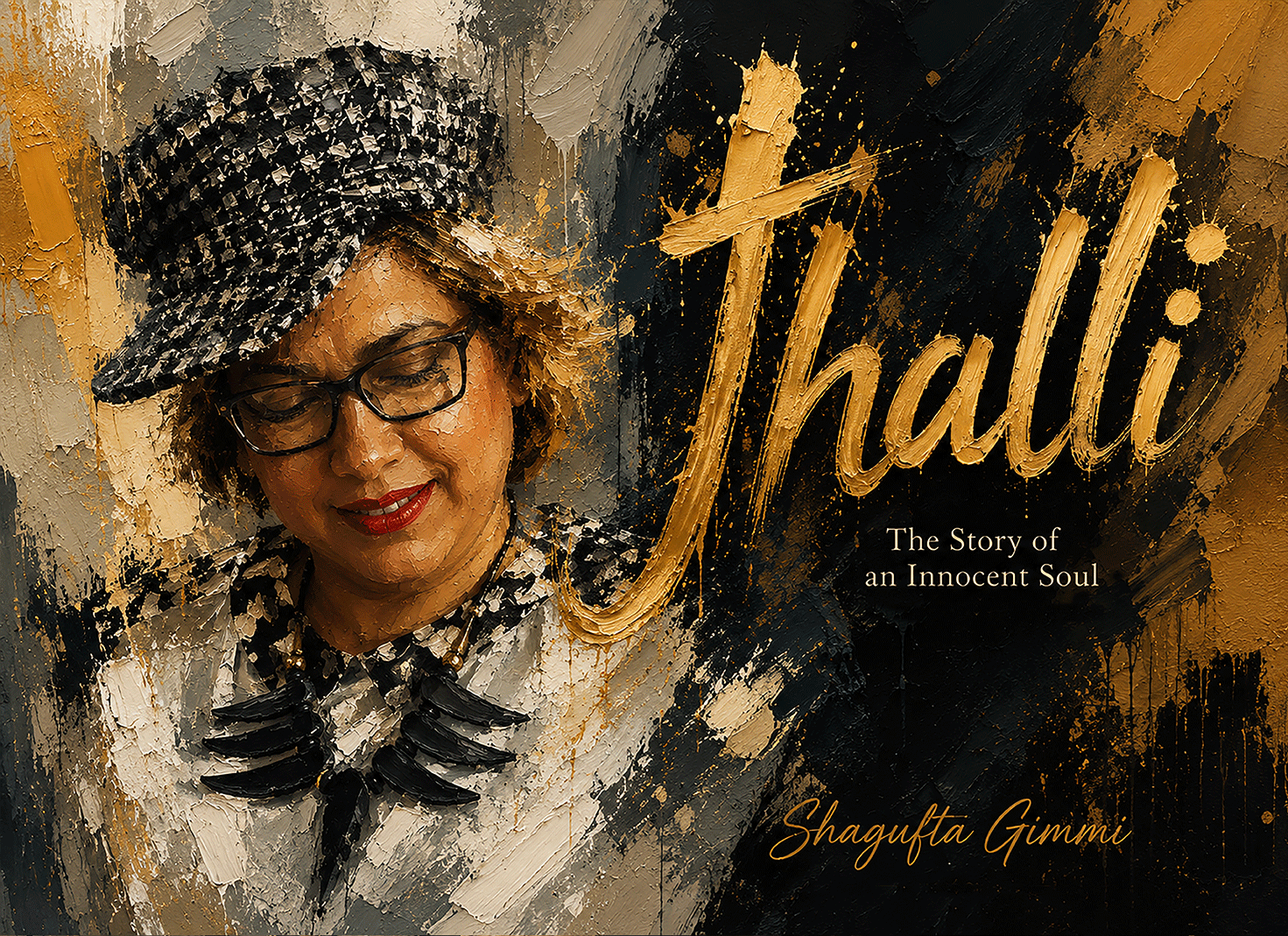
Jhalli
Jhalli is the story of Firdous, a sensitive and intelligent woman searching for love, dignity, identity, and inner peace in a society shaped by patriarchy, class divisions, and social expectations. Separated from her first love, Farid, she is forced into a marriage that offers neither companionship nor happiness. Trapped in a controlling family environment, she endures loneliness, betrayal, and emotional hardship while witnessing the tragic decline of her father, Aslam, whose unfulfilled dreams deeply influence her life. Through friendship, suffering, and self-reflection, Firdous gradually learns that true freedom cannot be found in the approval of others. In the novel’s final chapters, symbolic conversations with an ancient banyan tree guide her toward a deeper understanding of faith, dignity, and selfhood. Ultimately, Jhalli is a powerful story of resilience, self-discovery, and the journey toward inner wholeness.